If your law firm has fewer than 50 attorneys, you're exactly the kind of target cybercriminals are looking for.
Law firm data breach activity has climbed sharply in recent years, and small and mid-sized practices are absorbing the brunt of it. Attackers assume smaller firms are easier to breach: fewer defenses, less oversight, no dedicated IT security staff watching the perimeter.
They're often right.
According to Checkpoint Research, legal professionals are now facing more than 1,000 cyberattacks per week, a 13% increase year over year. That's not a statistic that only applies to Am Law 100 firms with in-house security teams. It applies just as much, arguably more, to a 12-attorney practice in Napa or a boutique firm in San Diego.
Why Data Security Matters More Than Ever for Small Law Firms
Clients don't just hire a law firm for legal expertise. They're trusting that firm with some of the most sensitive information in their lives: financial records, medical records, health insurance information, social security numbers, trade secrets, and confidential case files that could include everything from custody disputes to trade secret litigation.
A single security breach can compromise all of that at once. And the fallout isn't limited to the IT department. It touches client trust, malpractice exposure, bar association scrutiny, and the firm's ability to keep operating normally while the incident gets sorted out.
These aren't hypothetical risks. They're active, ongoing threats hitting firms of exactly this size, right now.
What Makes Law Firms So Vulnerable to Cyberattacks?
Cybercriminals aren't chasing the biggest targets. They're chasing the ones they believe will be easiest to breach, and smaller law firms often fit that profile for a few specific reasons.
Common Attack Methods
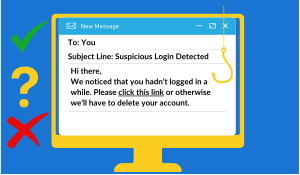
Phishing and social engineering attacks. Attackers impersonate clients, opposing counsel, or even partners within the firm to trick staff into wiring funds, sharing login credentials, or opening malicious attachments. Law firms are especially attractive targets for this because email is the primary communication channel for nearly every matter.
Ransomware attacks. Once inside a network, attackers encrypt client files and case documents, then demand payment before they'll release them. For a firm with active litigation deadlines, even a short outage can be devastating.
Credential theft and unauthorized access. Weak or reused passwords, combined with a lack of multi-factor authentication, give attackers an easy path into email accounts and document management systems. Stolen credentials often surface for sale on the dark web long before a firm realizes anything happened.
Data leaks from unsecured remote access. Remote and hybrid work expanded the attack surface for every industry, and legal is no exception. Unsecured VPNs, unmanaged personal devices, and poorly configured cloud storage all create paths in.
What Hackers Are Counting On
- No formal cybersecurity policy
- Outdated or scattered security tools that don't talk to each other
- Unsecured remote access
- No documented incident response plan
- Staff who haven't been trained to recognize phishing attempts
According to the American Bar Association, 17% of firms still operate with no cybersecurity policy at all, and 79% have no incident response plan in place. If your firm doesn't know how it would respond to a breach today, that uncertainty is exactly what attackers are betting on.
The Regulatory and Ethical Landscape Law Firms Can't Ignore
Data security for law firms isn't just a business risk. It's an ethical obligation. Most state bar associations, including California's, require attorneys to take reasonable measures to protect client data as part of their duty of confidentiality. Falling short of that standard can expose a firm to disciplinary action independent of any lawsuit a client might bring.
On top of bar obligations, several regulatory frameworks apply directly to firms handling certain types of sensitive information:
- The California Consumer Privacy Act (CCPA) gives California residents specific rights over their personal information, and firms that handle client data for California-based individuals need policies in place to support those rights.
- HIPAA applies when a firm's practice touches medical records or health insurance information, common in personal injury, workers' compensation, and estate planning work.
- The Federal Trade Commission (FTC) Safeguards Rule sets baseline expectations for how businesses, including many professional services firms, protect consumer financial information.
None of this requires a firm to become a compliance shop overnight. It does mean that "we didn't have a policy" is no longer a defensible position, either to a regulator, a bar association, or a client's cybersecurity attorney reviewing what went wrong after the fact.
Signs Your Firm's Current Security Posture Has Gaps
Most firms don't realize how exposed they are until something goes wrong. A few warning signs worth checking against your own setup:
- Staff share logins or reuse the same password across multiple systems.
- No one on the team could tell you, right now, what the firm's incident response plan actually says, because it doesn't exist.
- Client files, medical records, or financial documents move through email without encryption.
- Former employees or contractors still have active access to firm systems.
- No one is monitoring for compromised data or login credentials showing up outside the firm's own network.
- The last security review happened more than a year ago, or never happened at all.
Any one of these on its own is a manageable gap. Several of them together describe a firm operating on borrowed time, one that a threat actor scanning for easy targets will find quickly.
What Happens After a Data Breach in a Law Firm?
Here's what a firm is realistically looking at after a confirmed security breach:
- Direct financial impact, often tens of thousands of dollars once you factor in forensic investigation, legal counsel, client notification, and credit monitoring for affected individuals.
- Lost productivity while the team is pulled into incident response instead of billable work.
- Reputational damage, which lands harder in the legal industry than almost anywhere else, since referrals inside close-knit legal and business communities depend heavily on trust.
- Client attrition. A meaningful share of clients leave a firm permanently after a breach, particularly if they feel the firm was slow to disclose or unprepared to respond.
- Regulatory and legal exposure, including the possibility of a data breach lawsuit from affected clients, especially in states like California and New York where privacy statutes give individuals a private right of action or strengthened enforcement mechanisms.
This isn't only an IT problem. It's a business continuity problem, and increasingly, a legal one.
There's also an intellectual property dimension that's easy to overlook. Firms working on transactional matters, licensing agreements, or IP litigation often hold trade secrets and proprietary business information belonging to their clients, not just personal data. A breach that exposes that kind of confidential information can create liability that has nothing to do with personal privacy law and everything to do with the underlying business relationship the firm was hired to protect.
Law Firm Cybersecurity Best Practices You Can Put in Place Today
You don't need a full internal security team to materially improve your firm's security posture. These are the fundamentals that address the vulnerabilities attackers rely on most:
- Create a documented cybersecurity policy covering acceptable device use, remote access rules, and client data handling procedures.
- Train your staff to recognize phishing attempts, verify wire transfer requests out of band, and avoid unsafe links and attachments.
- Require multi-factor authentication on email, document management, and any system holding client data.
- Encrypt sensitive client data, especially on laptops, mobile devices, and anything accessed remotely.
- Monitor for compromised credentials. Firms with visibility into dark web exposure can rotate stolen login credentials before an attacker uses them.
- Keep software patched and run regular vulnerability scans to address vulnerabilities before they're exploited.
- Build an incident response plan, even a simple one, so the firm isn't improvising in the middle of an active breach.
Each of these addresses a specific gap on the list above. None of them require an enterprise security budget to implement well.
You Don't Need to Be a Cybersecurity Expert. That's Our Job.
At Endsight, we work exclusively with small and mid-sized organizations across California and Hawaii, including a significant number of law firms, and we understand the specific pressures legal practices face: tight deadlines, high client expectations, strict confidentiality obligations, and often no dedicated internal IT security staff.
Our managed IT and cybersecurity services for law firms are built around exactly this problem. We help firms put reasonable, defensible security measures in place, meet their compliance and ethical obligations, and keep their teams productive without adding unnecessary complexity.
If you want a closer look at how the current threat landscape applies specifically to legal practices, our law firm cybersecurity resource walks through the details.
Frequently Asked Questions
How common are data breaches at small law firms? More common than most firms assume. Legal professionals face over 1,000 cyberattacks per week industry-wide, and smaller firms are frequently targeted precisely because they tend to have fewer defenses in place than larger organizations.
What's the average financial impact of a law firm data breach? Costs vary by firm size and the type of data involved, but small firms typically face tens of thousands of dollars in direct costs once forensic investigation, client notification, credit monitoring, and lost billable time are factored in. That figure doesn't include reputational damage or potential client attrition.
Do law firms have a legal obligation to protect client data? Yes. Beyond any specific statute, most state bar associations require attorneys to take reasonable measures to protect client confidentiality as part of their core ethical obligations. Depending on the type of data involved, additional frameworks like the CCPA, HIPAA, or the FTC Safeguards Rule may also apply directly.
What's the first step a small firm should take to improve its security posture? Start with a documented cybersecurity policy and an incident response plan. Both are foundational, inexpensive relative to the risk they address, and immediately close two of the most common gaps attackers rely on.
Final Word: Data Security Is No Longer Optional for Law Firms
If your firm has been putting off a real plan to address its security posture, the volume and sophistication of current cyber threats make this the year to act. Client trust, bar compliance, and the financial stability of the practice all depend on it.
Your clients expect it. Your firm depends on it.
Talk to an Endsight security advisor about where your firm's biggest gaps are, and what it would take to close them.


 Industries
 Geographies
 Architecture
 Construction
 Law Firms
 Nonprofit
 Wineries
 Finance
 IT Support Services
 Cyber Security Services
 Apps, Analytics & A.I.
 IT Help Desk
 IT Strategy
 Fin. Tech
 Microsoft 365
 IT Procurement
 IT Projects
 IT Administration
 Microsoft Teams Voice
 Managed Backup
 MSSP
MSSP
 Training
 Office Hours
 Security Shorts
 Artificial Intelligence
 Dashboards
 Workflows
 Integrations
 Custom Applications
 Core values
 Client testimonials
 Articles
 Helpful Resources
 Endsight team
 Awards
 Vendor partners
 Webinar Library
.jpg)